Welcome to 2020 and before us the start of the new year and, more importantly, the start of a new decade. So lets start out with a strong, confident approach and make sure we all understand this newish technology called eUICC, eSIM, and even iSIM.
This Part 2 of the discussion will refine and define observations that have been generally stated in Part 1 (R6); examine more closely eSIM and eUICC aspects. Due to the huge amount of material that needs to be condensed, as per the last post (Part 1) a heavy use of references will be given for further reading or in support of observations made in Part 2. Moreover, Part 2 will need to be posted in sections (Part 2.1, Part 2.2, etc.) so as not to blur the concepts being discussed and overloading the reader with excessive information in a blog post.
CONNECTIVITY - AA.35
To foster the goal of seamless global connectivity GSMA has developed and published 'AA.35' (R7). In brief, this document defines the GSMA's policy and procedures for global vision for the creation and adoption of Industry specifications. It is an important document, and not just from a management perspective or GSMA's paternal role, but explains the how's and why's of how various aspects of operability, interoperability and interworking essential in the telecommunications ecosystem requires to have a balanced approach. That means with respect to the GSMA membership (the participants):
"Industry Specifications are defined in AA.35 as "any specification for: (i) common adoption ; and (ii) repeated implementation, application and functioning ; and (iii) general use, operations and support in multiple segments of the telecommunication ecosystem ; or (iv) consistent testing, verification and certification; of technology that would directly and materially affect simultaneously mobile network operators and non-mobile network operator participants within the mobile industry ecosystem. Industry Specifications do not include specifications that: (i) only affect interoperability or interworking between mobile network operators ; or (ii) do not add additional specifications to technical solutions ." AA.35 section 3 .3." (R8)
Observation: In a nutshell interpretation of the above it seems to me might suggest those who voluntarily enter into creating or participating with Industry specification may, as a case in point, be making a form of Hippocratic Oath: "make a habit of two things - to help or at least to do no harm."** (R9). I have suggested 'Oath': as it is already international recognised; Antitrust seeks to prevent harmful restriction; GSMA is seeking international acceptance of AA.35; and participants undertake not to be the cause-bringer of harmful disruption.
A further glimpse into why AA.35 is an important document can be found in the DoJ response Wednesday, November 27, 2019 (R10) to the Business Letter Review. I think once I read the DoJ's release I could envisage eUICC, eSIM, and iSIM having more appeal to handset manufacturers to open up a technology-advantage over older handsets and create a competitive-advantage. Three pertinent paragraphs in the DoJ release that are supportive of that are:
"The GSMA expressed its intent to adopt the new procedures in a request for a business review letter from the Antitrust Division. After completing its investigation, the division is today issuing a business review letter that expresses concern about the past procedures and some of the resulting provisions in the standard. The letter concludes, however, that the proposed changes appear to adequately address those concerns. In light of these planned changes, the Antitrust Division has no present intention to bring an enforcement action against the GSMA or its mobile network operator members." (para 2)
So there is, at present, no barrier enforced/encumbent barrier deterring adoption.
" “I am pleased that the GSMA is ready to use its standard-setting process to create a more consumer-friendly eSIM standard,” said Assistant Attorney General Makan Delrahim. “The GSMA’s old procedures resulted in certain eSIMs rules that benefitted only its incumbent mobile network operators at the risk of innovation and American consumers. The new procedures proposed going forward significantly reduce that risk and should result in new innovative offerings for consumers.” " (para 3)
The principle of a level playing field (commonality) brought about by consumer-friendly eSIM standard will have a huge appeal to suppliers and consumers alike. I suppose (in an imaginative way) this might be thought about in terms similar to that when 'Java' first came out - hiding the complexities of a range of disparate devices/systems in order that they may communicate together.
" "The mobile communications industry has begun to migrate away from traditional SIM cards—a removable plastic card that is preprogrammed to connect to a single mobile network—and toward innovative eSIMs, which perform the same function as a SIM card but are soldered into the device and capable of being remotely programmed and re-programmed to connect to different operators’ mobile networks. The mobile industry refers to this process as Remote SIM Provisioning (RSP)." " (para 4)
And finally, acquisition of an approved profile using GSMA's development called Remote SIM Provisioning (RSP), what I would describe as being similar to a Passport Office. If you don't have a Passport, you can't travel.
In the next article (Part 2.1) I will define and refine further handling GSMA Documents and Standards (3GPP/ETSI) that is discuss how we use standards and how Documents have influence.
(R6) https://trewmte.blogspot.com/2019/12/esim-observing-possible-outcomes-part-1.html
(R7) Provisions for the Policy and Procedures for Official Document in relation to Industry Specifications - AA.35 Version 1.0.0 - 1 5th March 2019
(R8)CLIFFORD CHANCE US LLP Confidential Treatment Requested by Clifford Chance US LLP on Behalf of The GSM Association July 25, 2019 addressed to Assistant Attorney General Antitrust Division Department of Justice (document released by DoJ following its Antitrust review in Business Request Letter from the GSMA legal advisors).
(R9) **Epidemics I:XI. The commonly cited Jones translation follows Littre and goes: "make a habit of two things —to help, or at least do no harm" (Hippocrates [1923a]). Jonsen notes that the Greek text does not contain the words "at least." Jonsen AR. "Do No Harm." Ann Int Med 1978;88:827-32. I have used a later translation (Hippocrates [1950]).
(R10) Department of Justice Office of Public Affairs Justice Department Issues Business Review Letter to the GSMA Related to Innovative eSIMs Standard for Mobile Devices Wednesday, November 27, 2019
Showing posts with label Remote SIM Provisioning Service (RSP) Architecture. eUICC. Show all posts
Showing posts with label Remote SIM Provisioning Service (RSP) Architecture. eUICC. Show all posts
Thursday, January 09, 2020

Friday, December 06, 2019
eSIM - Observing Possible Outcomes Part 1
Back in 2012 I wrote about the introduction of a new form factor for SIM Cards (4FF). The outline and a potted history of SIM Card form factors were illustrated and in a separate post the first ETSI standard defining this new form factor (4FF) - (R1) and (R2).
Seven years down the line in (2019) ARM Limited produced a useful graphics of where eSIM is placed in the evolutionary chain of form factors - (R3).

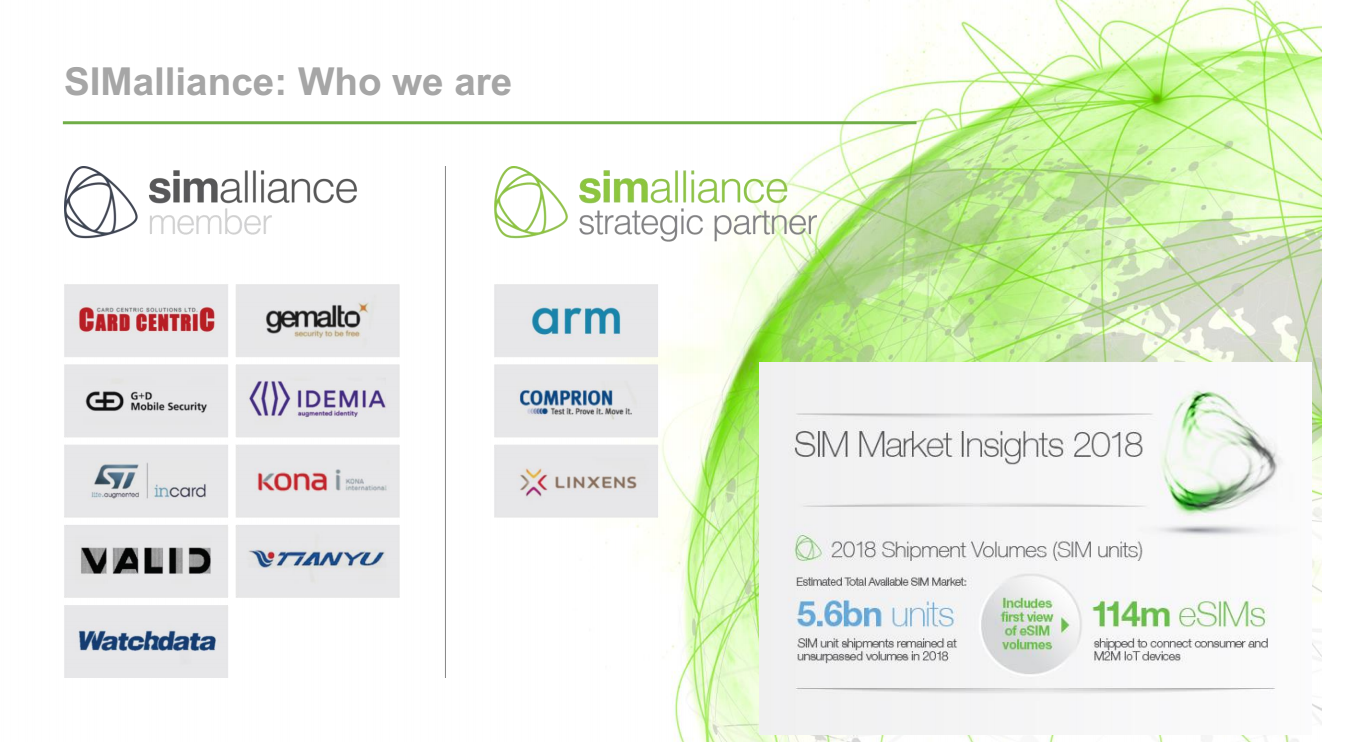
eSIM has already established a presence in the digital tech marketplace. SIMalliance published SIM Market Insights in June 2019 giving the following stats '2018 Shipment Volumes (SIM Units)'. Here again it is easier to show the graphics than simply record word-for-word the stats - (R4).

Recorded in in Arm's presentation are more stats 4.4 billion cellular devices by 2025 – Source: Machina 2017; $1.8 trillion operator revenue opportunity for LPWAN by 2026 – Source: GSMA 2017 to support the vision of eSIMs integration into future devices and market size - (R3).
There are, of course, numerous market reports predicting how eSIM will fair in the marketplace; this blog post is giving a potted history just to bring the discussion up to speed.
Specifications and standards for eSIM/eUICC are available from 3GPP, GSMA and SIMalliance. These will be discussed in another Part to this blog discussion. For now, what is required to know is how eSIM will actual operate in practice. The SIMalliance produced a helpful graphic (R4) showing eSIM profile (a package), delivered to a physical product (eUICC), when deployed in the field. So let us look at that first.
 For the download (update) system architecture to work requires both network and device to operate and function according to the Remote SIM Provisioning Service (RSP) Architecture'. This has been designed into the RSP Architecture. The following graphics helpfully illustrate two important element: the network side and the device side (eUICC) - (R5).


Once the eUICC has been deployed in the field [it], when inserted into a compatible smartphone, will be able to download one or more mobile operator profiles and then subscribed services. An eSIM user can then switch between operator profiles or download profiles and services on the fly - time, place and location, and so on. This enables the eSIM/eUICC to excel in connectivity. This approach to connectivity is exciting and yet remarkable, for logically the SIM Card issued previously was issued and controlled by the subscriber's mobile operator. eSIM/eUICC in essence removes sovereignty which was jealously guarded by each operator prior to the intro of this technology handover. That is even to the extent where virtual mobile operators (VMOs) only functioned based upon piggy-backing off primary operators' core network but issued their own SIM Cards.
It should be understood that the envisaged usage for eSIM focussed on M2M, so candidates would be industry devices, automobiles, metering and so on. But the concept of eSIM has recently engaged operators and handset manufacturers to look at how 5G can help with profiling and service downloads. Recently, GSMA ran seminars with hands-on training for eSIM profiling and services download, which apparently was very successful.
Moreover, Samsung, Google and Apple have devices with eSIM capability.Android framework provides standard APIs for accessing eSIM and managing subscription profiles on the eSIM (Android 9). Importantly, Devices running Android 10 or higher can support devices with multiple eSIMs. So these factors alone are investigative elements for cyber security oversight, pentesters and forensic examiners to be aware.
In Part 2 the discussion will refine and define observations that have been generally stated in this post; examine more closely eSIM and eUICC aspects and then more in Parts 3 and 4 looking at potential implications for cyber security, law enforcement, forensic examiners and ICT specialists.
REFERENCES
(R1) SIM Card new 4FF form factor size - https://trewmte.blogspot.com/2012/06/sim-card-new-4ff-form-factor-size.html
(R2) ETSI release details of new 4FF UICC - https://trewmte.blogspot.com/2012/06/etsi-release-details-of-new-4ff-uicc.html
(R3) The Challenges Deploying IoT eSIM M2M enabling Secure Communications Scaled for 1 trillion devices. Jean-Philippe Betoin Marketing Director, Secure Identity Confidential © 2019 Arm Limited.
(R4) SIMs, eSIMs and Secure Elements: Providing a roadmap to dynamic security and flexible control for connected devices. Remy Cricco Chair of the Board, SIMalliance ETSI Security Week June 2019.
(R5) GSMA SGP.21 - RSP Architecture, V2.2, 1 Sep 2017
Seven years down the line in (2019) ARM Limited produced a useful graphics of where eSIM is placed in the evolutionary chain of form factors - (R3).

eSIM has already established a presence in the digital tech marketplace. SIMalliance published SIM Market Insights in June 2019 giving the following stats '2018 Shipment Volumes (SIM Units)'. Here again it is easier to show the graphics than simply record word-for-word the stats - (R4).
Recorded in in Arm's presentation are more stats 4.4 billion cellular devices by 2025 – Source: Machina 2017; $1.8 trillion operator revenue opportunity for LPWAN by 2026 – Source: GSMA 2017 to support the vision of eSIMs integration into future devices and market size - (R3).
There are, of course, numerous market reports predicting how eSIM will fair in the marketplace; this blog post is giving a potted history just to bring the discussion up to speed.
Specifications and standards for eSIM/eUICC are available from 3GPP, GSMA and SIMalliance. These will be discussed in another Part to this blog discussion. For now, what is required to know is how eSIM will actual operate in practice. The SIMalliance produced a helpful graphic (R4) showing eSIM profile (a package), delivered to a physical product (eUICC), when deployed in the field. So let us look at that first.


Once the eUICC has been deployed in the field [it], when inserted into a compatible smartphone, will be able to download one or more mobile operator profiles and then subscribed services. An eSIM user can then switch between operator profiles or download profiles and services on the fly - time, place and location, and so on. This enables the eSIM/eUICC to excel in connectivity. This approach to connectivity is exciting and yet remarkable, for logically the SIM Card issued previously was issued and controlled by the subscriber's mobile operator. eSIM/eUICC in essence removes sovereignty which was jealously guarded by each operator prior to the intro of this technology handover. That is even to the extent where virtual mobile operators (VMOs) only functioned based upon piggy-backing off primary operators' core network but issued their own SIM Cards.
It should be understood that the envisaged usage for eSIM focussed on M2M, so candidates would be industry devices, automobiles, metering and so on. But the concept of eSIM has recently engaged operators and handset manufacturers to look at how 5G can help with profiling and service downloads. Recently, GSMA ran seminars with hands-on training for eSIM profiling and services download, which apparently was very successful.
Moreover, Samsung, Google and Apple have devices with eSIM capability.Android framework provides standard APIs for accessing eSIM and managing subscription profiles on the eSIM (Android 9). Importantly, Devices running Android 10 or higher can support devices with multiple eSIMs. So these factors alone are investigative elements for cyber security oversight, pentesters and forensic examiners to be aware.
In Part 2 the discussion will refine and define observations that have been generally stated in this post; examine more closely eSIM and eUICC aspects and then more in Parts 3 and 4 looking at potential implications for cyber security, law enforcement, forensic examiners and ICT specialists.
REFERENCES
(R1) SIM Card new 4FF form factor size - https://trewmte.blogspot.com/2012/06/sim-card-new-4ff-form-factor-size.html
(R2) ETSI release details of new 4FF UICC - https://trewmte.blogspot.com/2012/06/etsi-release-details-of-new-4ff-uicc.html
(R3) The Challenges Deploying IoT eSIM M2M enabling Secure Communications Scaled for 1 trillion devices. Jean-Philippe Betoin Marketing Director, Secure Identity Confidential © 2019 Arm Limited.
(R4) SIMs, eSIMs and Secure Elements: Providing a roadmap to dynamic security and flexible control for connected devices. Remy Cricco Chair of the Board, SIMalliance ETSI Security Week June 2019.
(R5) GSMA SGP.21 - RSP Architecture, V2.2, 1 Sep 2017
Subscribe to:
Posts (Atom)