For the last two years Chapter 18, Smith et al have been studying AKA (authentication and key agreement). One candidate for AKA is MILENAGE which, in 2014 & published 2015, was hacked using DPA (a side channel attack).
Having spent 2016 researching through a huge range of document, presentation, test data and scripts etc., it was noted there had been nothing written as to what to look for and how practitioners could handle this information. It is hoped with the discussion, embedded links and those willing to learn this presentation goes some way to help in that regard.
fcord-2016-USIM-MILENAGE-0x48.pdf
Showing posts with label cloning. Show all posts
Showing posts with label cloning. Show all posts
Thursday, January 19, 2017

Saturday, September 14, 2013
PIN Enabled SIM Card
PIN Enabled SIM Card
A recent question raised the notion what data would be revealed if the SIM Card was read but had a PIN enabled. Using a free SIM Card reader the results are below. Do remember, using different readers their output can reveal different results dependent upon how the programmer wrote the software. The results are from an old Phase 2 GSM SIM Card.


Additional tests with the PIN Locked SIM Card conducted with different SIM Readers


A recent question raised the notion what data would be revealed if the SIM Card was read but had a PIN enabled. Using a free SIM Card reader the results are below. Do remember, using different readers their output can reveal different results dependent upon how the programmer wrote the software. The results are from an old Phase 2 GSM SIM Card.


Additional tests with the PIN Locked SIM Card conducted with different SIM Readers


Friday, June 21, 2013
PIN Enabled SIM Card
PIN Enabled SIM Card
A recent question raised the notion what data would be revealed if the SIM Card was read but had a PIN enabled. Using a free SIM Card reader the results are below. Do remember, using different readers their output can reveal different results dependent upon how the programmer wrote the software. The results are from an old Phase 2 GSM SIM Card.
Additional tests with the PIN Locked SIM Card conducted with different SIM Readers
A recent question raised the notion what data would be revealed if the SIM Card was read but had a PIN enabled. Using a free SIM Card reader the results are below. Do remember, using different readers their output can reveal different results dependent upon how the programmer wrote the software. The results are from an old Phase 2 GSM SIM Card.
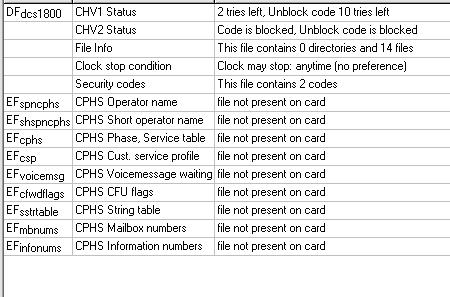
Additional tests with the PIN Locked SIM Card conducted with different SIM Readers
Sunday, October 14, 2012
To Clone or NOT to Clone?

The purpose of this article is to reiterate the issues surrounding the best practice model of the forensic examination/data harvesting of mobile telephones and the isolation of radio signals. It’s not the intention of the author to critique any persons/methods or vendors of products/services but merely to highlight the issues which are still apparent today considering such methods have been adopted for well over ten years in the field of mobile phone forensics and which in the opinion of the author are yet to be addressed to a satisfactory level.
Best practice advocates the need to isolate the target device from any communication signal in order to prevent changes in existing live/deleted recoverable data. Bearing this in mind the most common practice is to utilise U/SIM cloning tools and to replicate a working copy of the target U/SIM or in some cases creating a working U/SIM for those target devices where the original U/SIM is not available. The majority or most commonly adopted tools/applications for such a method will only permit the examiner to copy the minimal data required to allow successful boot which are the ICCID and IMSI in the main with the addition of other parameters such as the MNC. Although it may be regarded as best practice in the main it’s not without issue. From experience and review/re-examination of cold and live cases the same problems are encountered yet not addressed to a satisfactory level.
There are several vendors of such products and in the main they are adequate to a degree however some vendors of such products do not appear to continue with the product development cycle of such functions as one would expect. We see improvements and development with the core functions of mobile phone forensic applications and that is most welcomed however the basic fundamental process in this case cloning of the target U/SIM are left behind. Thus how is it possible to continue or improve upon a best practice model if the basic fundamental requirements are not addressed?
Examples where failings have been noted are listed below:
1. Misrepresentation of acquired/harvested data:
Quite often through examination it has been noted certain data types are not translated or presented in the correct format. For example contact names may be missing as they are contained within the ADN of the U/SIM card and due to the cloning system have not been transferred through which in turn is replicated to other data sets such as SMS and call list.
2. Inaccessible data
Situations have been encountered where data is not available via the GUI of the target device thus the possibility of missing or non-examination of data exists. An example of this was encountered whilst examining a BlackBerry Bold device where the BBM application was not available without the use of the original target U/SIM, the reason being that the application or some functions were tied to the SIM Application Toolkit.
The above examples are just the tip of the iceberg and in the opinion of the author there are certainly more issues encountered in the use of U/SIM cloning systems when examining mobile telephones and/or devices which utilise the use of U/SIM cards.
So how can we overcome such issues and improve upon the best practice model? One solution is total radio isolation and the use of the original target U/SIM i.e. faraday enclosures/rooms. Unfortunately this option is not a satisfactory way forward due to cost, health & safety issues, practicality and when dealing with volume work.
For a more practical and sustainable solution the author would suggest that the vendors of such products/services review their product development cycle, obtain and work with the necessary feedback from seasoned practitioners with a view to providing far more robust products/services which at best eliminate U/SIM cloning issues or which offers the examiner more flexibility as to the cloning parameters required or at least work towards providing bulletins of known issues and possible solutions for identified issues.
Author: Vinny Parmar
Digital Forensic Practitioner
Accredited MTEB Mobile Phone Trainer
Tuesday, November 02, 2010
Smart Card Hacking
Smart Card Hacking
Back in 2002 I wrote about SIM Card Cloning for examiners to demonstrate the state of the market place, where software and hardware was being openly promoted that researchers could obtain and what might an examiner be exposed to when examining a cloned SIM Card. A copy of that report can be downloaded here:
SIM Card Cloning
http://www.4shared.com/document/GMz_Gqcc/Special_Edition_2002_SIM_Cloni.html
In 1998 I circulated a report (UPD5-1 Vol1 - FEN98) on Smart Card Hacking to members of the British Association of Criminal Experts (BACE). The archive report has been scanned page by page and put into acrobat.pdf format and can now be downloaded here:
Smart Card Hacking
http://www.4shared.com/file/kq5NGzns/UPD5-1_Vol1_-_FEN98.html
The smart card hacking report has an interesting description for classification of the various levels of criminal activity in addition to techniques of smart card hacking. This particular report was the one that inspired me to write about SIM Card Cloning for exmainers. Once again thanks and respect to Ross Anderson and Markus Kuhn.
It is important to consult the laws of the country you are in when dealing with research for cloning SIM Cards. This blog article does not promote or advocate anyone to break the law by cloning or attempting to clone SIM cards for the purposes of obtaining services or breaching property rights belonging to respective particular network operators etc.
Subscribe to:
Posts (Atom)